


Smart AR glasses in industrial workflows: OEM notes
Views: 0 Author: Site Editor Publish Time: 2026-07-08 Origin: Site


The manufacturing sector is currently experiencing a massive operational shift. We are rapidly moving away from conceptual augmented reality pilots. Today, production-grade deployments dominate modern plant environments. Consumer augmented reality devices often prioritize deep immersion. However, industrial applications demand extreme reliability, strict safety compliance, and seamless workflow integration. You cannot simply hand a floor worker a headset and expect immediate efficiency gains. Plant managers face real, practical challenges when deploying these tools effectively across a workforce.
We created this practical, hype-free evaluation guide for technical directors and operational leaders. You will learn how to accurately shortlist hardware, structure software integrations, and overcome frontline resistance. You will also discover how to navigate the complex convergence of IT and OT networks securely. Ultimately, this framework ensures you deploy wearables exactly where they move the needle on operational efficiency.
Key Takeaways
Success relies on targeted metrics: High-ROI deployments focus strictly on first-time fix rates, training time reduction, and hands-free data access, not general "digital transformation."
Hardware trade-offs are inevitable: The balance between battery life, processing power, and the necessity of lightweight AR glasses dictates worker adoption rates.
IT and OT convergence is mandatory: Professional AR glasses must securely bridge operational environments with enterprise ERP/MES systems without introducing network vulnerabilities.
Pilot purgatory is a known risk: Successful rollouts require defining strict scalability thresholds and user-acceptance criteria before the hardware purchase.
Defining Success: When to Deploy Industrial Smart AR Glasses
Leaders often struggle to frame the exact business problem before buying hardware. Standard rugged tablets work perfectly fine for simple data entry. However, they force workers to look down and occupy their hands. Some workflows absolutely require true hands-free spatial computing. You must contrast situations where a clipboard suffices against environments demanding real-time visual overlays. Deploying industrial smart ar glasses makes sense only when the physical task requires undivided visual attention and manual dexterity simultaneously.
You need to establish firm success criteria and operational baselines. Without these, your deployment will stall. Below are the primary metrics you should track:
Maintenance & Downtime: Track your mean time to repair (MTTR). Measure this metric when engineers have instant access to digital schematics. Compare it to legacy paper-based repair times.
Quality Assurance (QA): Monitor end-of-line defect rates. Use step-by-step visual overlays during complex assemblies. Document how this reduces omission errors.
Training & Onboarding: Quantify the exact reduction in shadow-training hours. Measure how fast new floor operators reach full productivity using guided workflows.
A crucial best practice involves baseline measurement. We strongly advise setting these baseline metrics before introducing any hardware. Measure your current MTTR and defect rates for thirty days. You must know your starting point to accurately measure the workflow delta later. Accurate measurement proves the project's viability to senior stakeholders.
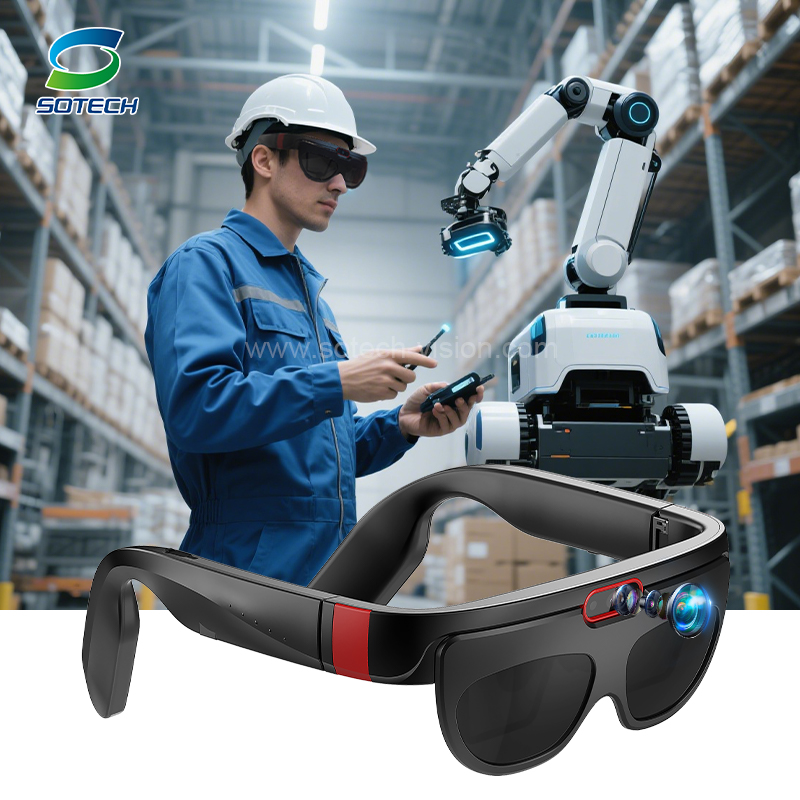
High-Value OEM Workflows for Professional AR Glasses
Finding the right workflow is critical. You should not deploy augmented reality for every factory task. Precision targeting yields the best results. Complex assembly guidance stands out as a prime use case. High-variance manufacturing environments often suffer from omission errors. Workers might forget a specific torque sequence or misplace a fastener. Step-by-step digital work instructions prevent these mistakes. The glasses project visual cues directly onto the physical asset. This ensures operators complete each step sequentially before moving forward.
Remote expert assistance represents another massive value driver. The industry often calls this the "see-what-I-see" approach. Tier-3 support engineers cannot be everywhere at once. Flying an expert across the country causes massive delays. Instead, you can securely connect remote experts to frontline technicians in real time. The expert sees exactly what the technician sees through the device's camera. They can annotate the technician's field of view. This completely bypasses travel costs and drastically reduces machine downtime.
Maintenance, Repair, and Overhaul (MRO) tasks also benefit heavily from professional ar glasses. Legacy machinery rarely features modern digital interfaces. Wearables solve this by superimposing digital twin data onto older physical machines. Technicians can view live IoT sensor data, temperature readings, and predictive maintenance alerts hands-free.
Finally, logistics and kitting workflows see immediate improvements. Warehouse workers traditionally juggle clipboards, RF scanners, and physical boxes. Heads-up displays enable pick-by-vision tasks. The glasses highlight the exact bin location. They can also utilize onboard cameras for instant barcode scanning. This significantly reduces physical scanner handling and accelerates the entire kitting process.
Hardware Evaluation: Trade-offs in OEM AR Glasses
Hardware selection requires a deep understanding of trade-offs. You must analyze the spectrum of available form factors. On one end, you have binocular mixed-reality headsets. They offer high compute power and spatial mapping. However, they are heavy and physically restrictive. On the other end, you find monocular assisted-reality wearables. These function as simple heads-up displays. They use minimal processing power but offer excellent all-day wearability.
Comfort dictates worker adoption rates. The comfort mandate is non-negotiable. Weight distribution matters more than total weight. Front-heavy devices cause severe neck fatigue after just two hours. Thermal management also plays a critical role. Processors generate heat. If a device runs hot against a worker's temple, they will take it off. Lightweight ar glasses usually win in continuous 8-hour shift environments because they respect these ergonomic boundaries.
Environmental durability determines whether the hardware survives the plant floor. Look closely at IP ratings and ruggedization standards. Plant floors require distinct water, dust, and drop resistance. An IP66 or IP67 rating is generally mandatory for heavy manufacturing. Furthermore, consider Personal Protective Equipment (PPE) compatibility. Devices must integrate seamlessly alongside hard hats, ear protection, and safety shields. They also need Z87.1 compliance for impact resistance.
Power management will make or break your deployment. Continuous video streaming drains batteries rapidly. You must evaluate shift management strategies. Some devices offer hot-swappable batteries. This allows workers to change batteries without rebooting the system. Others rely on tethered power packs worn on the belt. You must decide which compromise fits your specific physical environment.
Hardware Form Factor Comparison
Feature | Monocular Assisted Reality | Binocular Mixed Reality |
|---|---|---|
Weight Profile | Under 100 grams (Highly comfortable) | 300 - 600 grams (Front-heavy) |
Shift Viability | Full 8-hour shift support | 1-2 hours maximum continuous wear |
Compute Power | Low (2D overlays, video streaming) | High (3D spatial mapping, holograms) |
PPE Integration | Excellent (Clips to safety glasses) | Poor (Often replaces existing PPE) |
IT Security, Compliance, and System Integration
Deploying wearables introduces significant network considerations. You are placing mobile cameras into highly proprietary environments. Data security protocols must take priority. These devices stream live video and download proprietary CAD files. You must address how this data travels over facility Wi-Fi or private 5G networks. Ensure your selected OEM ar glasses support modern encryption standards like AES-256. Devices must authenticate securely without requiring frontline workers to type complex passwords on tiny virtual keyboards.
Mobile Device Management (MDM) integration is a strict requirement. Managing three devices is easy. Managing three hundred devices requires a robust infrastructure. Your IT team needs zero-touch provisioning capabilities. When a new device arrives, it should automatically configure itself upon connecting to the network. Remote wipe capabilities protect your data if a device goes missing. Centralized firmware version control ensures all units operate on patched, secure software.
Evaluate system agnosticism closely. The hardware must play nicely with your existing industrial software ecosystems. Do not buy devices locked into a single proprietary software suite. Your wearables need to integrate with SAP, Oracle, PTC Vuforia, or your custom Manufacturing Execution System (MES). The operating system, usually a variant of Android Open Source Project (AOSP), must allow custom APK sideloading. Seamless API integration connects the field worker directly to your central source of truth.
Overcoming Adoption Risks and Rollout Friction
Hardware and software matter, but humans determine your success. Frontline workers often resist new technology. You must transparently address this "Reddit Engineer" skepticism. Many mechanics and technicians have tried early-generation wearables and hated them. They complain about narrow Field of View (FOV). They report severe eye strain. They get frustrated by UI latency and clunky voice commands. Acknowledge these valid concerns upfront rather than dismissing them.
Implement specific mitigation strategies to build physical tolerance and trust:
Start small: Limit initial use cases to micro-tasks. Assign the glasses for 15-30 minute intervals. Do not force full-shift wear on day one.
Gather feedback: Actively solicit ergonomic feedback after these micro-sessions. Adjust display angles and nose pads based on their input.
Build advocacy: Involve senior floor technicians in the vendor shortlisting process. If the most respected mechanic signs off on the ergonomics, the rest of the team will follow.
Apply strict shortlisting logic before requesting vendor demos. First, audit your current Wi-Fi infrastructure capabilities. Dead zones in the factory will instantly kill a "see-what-I-see" video call. Second, request a proof-of-concept (PoC) hardware trial. Use it strictly for your most complex, high-error workflow. Do not test it on simple tasks. Finally, evaluate the vendor support Service Level Agreements (SLAs). Ensure long-term hardware availability so you aren't forced to replace your fleet next year. Smart ar glasses for industrial use require a reliable, multi-year support roadmap from the manufacturer.
Conclusion
Smart AR glasses are not a blanket solution for every factory problem. They remain a highly effective precision tool for specific, high-friction operational bottlenecks. Use them to fix communication gaps and procedural errors. We strongly emphasize that successful implementation is roughly 20% hardware selection and 80% change management.
If you fail to optimize the underlying workflow, the best hardware in the world will gather dust. Ensure you prioritize ergonomics, IT security, and baseline metrics. As an immediate next step, map out your top three highest-cost maintenance workflows. Document their current bottlenecks. Once you define these clear parameters, you can confidently request vendor demos and launch a successful rollout.
FAQ
Q: Can industrial AR glasses operate in completely offline environments?
A: Yes, many models support full offline functionality. You can download digital manuals, CAD files, and step-by-step workflows directly to local device storage before entering a dead zone. Devices utilize edge computing to process voice commands locally without internet access. They automatically sync completion logs and capture data back to the MES once they re-enter Wi-Fi coverage.
Q: How do lightweight AR glasses handle ambient factory noise during voice commands?
A: Factory floors exceed 90 decibels regularly. To combat this, enterprise-grade wearables use directional microphone arrays located near the mouth. They also incorporate AI-driven noise cancellation capabilities. These algorithms isolate the specific frequencies of human speech while filtering out continuous machine hums and sudden impact noises, ensuring accurate voice control.
Q: Are there prescription options for workers who already wear corrective lenses?
A: Absolutely. Most reputable vendors offer OEM-provided prescription inserts. These custom lenses snap securely behind the digital display. Alternatively, some larger monocular models feature an "over-the-glasses" design. This allows workers to wear their standard prescription safety glasses underneath the wearable device, ensuring both visual clarity and safety compliance.
Q: What is the realistic battery life during continuous video streaming?
A: Do not confuse standby time with active use. While a device might claim 8 hours of battery life, continuous "remote expert" video streaming drains it much faster. Expect roughly 90 to 120 minutes of continuous live video over Wi-Fi. For full-shift usage, you will absolutely need external, hot-swappable battery accessories mounted to a belt or hard hat.


